JeremiahBishop.com
Jeremiah Bishop: Adventurer – Coach – Consultant – X Pro Mountain Bike Racer
My #CanyonDIYtri Finish Line

As I lay exhausted in the grass at the finish of my first triathlon effort, a warm sense of achievement washed over me and a broad smile grew on my face.
On Saturday, I joined thousands of others in the first-ever #CanyonDIYtri – a do-it-yourself three-sport event that challenged athletes to set a goal, chart their course, and test themselves with a race-day triathlon effort.
I set up my course as a point-to-point swim-bike-run adventure to get back to my home.
At the start of my #CanyonDIYtri, I didn’t feel so great. The seasons were changing and weather had cooled. I had second thoughts as I looked at the cold slate-colored water I’d picked for my swim.
“What the hell am I doing here?” I thought as I stood on the dock procrastinating.
My physical therapist owns a farm about 15 miles from my house. On his farm there is a large pond. It took the same amount of time to drive there as it did to get me in that water.
Eventually, my kids commenced a countdown.
“10, 9, 8, 7, 6…”
SNAP my mind jumped into start line mode.
“5, 4, 3…”
A few deep breaths.
“2, 1…”
I was off!
I started with good energy and the sting of the cold water was invigorating. I made it through the first ten minutes, reached the turn, and accidentally took in a full cup of pond water and chokingly swallowed it.
Let’s just say the rest of my swim was plagued by a combination of fear and nausea with a side of vertigo. I made my way toward another dock, took a deep breath, and continued on.
‘Just 250 meters to my bike,’ I negotiated with myself.
I took my time in transition and was glad to pull on my warm socks. I began the bike-leg with a wobble, but as I rode, I warmed up and really started to enjoy the multi-sport feeling.
I got the Canyon Speedmax up to a solid tempo and the speed was shocking compared to my glacial swim.
Racing in three different modes? Now I can’t be stopped!
I transitioned to the run and my legs wanted circles but pithing a few minutes I found a steady groove. With my short stint of training, I was just going for a good sensation and I found it. I was scooping up miles with a good sweat rolling. As I entered my neighborhood, I knew I was going to make it! I was literally in the home stretch.
My only goal for the #CanyonDIYtri was to finish steady and get a good tempo workout in. Given my relative lack of swim and run preparations, even this was an ambitious goal.
I started developing minor cramps in my hips and hamstrings, but it was tolerable and I met the finish of my sub-Olympic triathlon with a huge smile on my face as my kids cheered me into our front yard.
Afterward, I realized how important it is to find your own finish line.
Strange places, experiences, and camaraderie are all best when delivered on the platter of the unexpected. Events are this platter, and the #CanyonDIYtri concept delivered. I was so happy to look on Instagram and see all the other posts tagging #CanyonDIYtri with the fun stories; like the guy who did a swim-bike-stroller jog; the lady who was 12 weeks post-surgery and finished with a walk on her crutches; there were folks that swam-biked-and ran from sunrise to sunset; and I was especially proud to see several other first timers who shared the fun of their very first triathlon with us.
I’m pretty sure I know what sport I’m best at, but now I’m a more well-rounded athlete and I’ve learned some new tricks; the least of which are physical.
A friend of mine who saw the video I made of the day, texted me with a concerned question, “How are you feeling, man?”
I actually felt great. It was a reminder of the great post-event buzz that blunts any soreness. The experience crystallized in my mind why I push myself. This is what we are built for: overcoming challenges!
Thanks to everyone who committed to the challenge, trained hard, and took the leap with us to do the #CanyonDIYtri. It was a cool experience! In fact, it was so cool I’ll definitely do it again; next time with a wetsuit.
Make sure to watch Friday’s Canyon 360 Labs live on YouTube. It will serve as an event recap with cool stories and awards presented by Dan Empfeild and Tri Tarren. It’s celebration time!
DIYtri Update: My First Brick

The Canyon #DIYTri is just 2.5 weeks away. With this, I am setting out to do something new. I am not going for a Fastest Known Time (FKT); for the first time in a long time, I am working to just get it done. I am just looking to finish with an increased thirst for beer, gain some fitness and have fun.
Now, let’s talk about some training. Being able to train again with purpose is good. Mostly.
My calves have a warm burning in a way that can only be described as the fire you might get from running up the ski slope. I just got off of doing 50 miles on Speedmax at a nice hard tempo. I am doing a brick workout for the first time. Sweat is stinging my eyes and I contemplate the normal ease of running this 3 mile lap. “Maybe I should save a little bit on the bike for my weak leg of running.”

A lot of the things I have seen in triathlon articles and photos are starting to make sense. People collapsing mid race with cramps, the use of sweat bands and towels in transitions and the obvious lack of gloves.
My training thus far has been going pretty well, although it is all of two weeks old. However our outdoor pool just closed so I got in only one swim in the last two weeks. The outdoor locations are getting cold but I am learning new tricks like the swim cap sandwich and to warm up before I get my swim on and keep in short.
I have to admit I’m learning more in the last 3 weeks than the last three years of cycling!
Everything from pace management for multisport to what swim workouts best focus on my weak kick much of it from Slowtwitch in fact. The forum is great for some answers and the beginner 21 week series is gold mine of great direction.
Of course, some things like neoprene booties for swimming probably are more novelty for me but dang if my aero position on the next gravel race is going to be super dialed. The reality is sometimes you just have to go to know. I will keep on learning from reading of course but the action of positive and negative reinforcement in the real world should make me a better athlete all around.
Pushing yourself is a process that is sure reap rewards now matter what you endeavor to do. This effort is already making me smile from that accomplished feeling of setting out to do something new and working to get it done!
On Becoming a GRVLR

Give a cyclist a route and they will ride for a day; teach them how to chart their course and they will adventure for a lifetime.
Great gravel riding is like a treasure hunt. There’s exploration and unknowns. If you set out unprepared, there’s a great chance you’ll walk through cow patties, get chased by junkyard dogs, or have to turn around where the road dead-ends.
It would be rad if there were more well-established gravel routes, but the hunt itself can be rewarding and a big part of the fun. Just like treasure hunts, you’ll have maps, but you must know how to use them.
Where to start?

Step One: Research
Many widely available mapping resources, like Google Maps, simply show what is passable to cellphone-wielding suburbanites in 4,000-pound SUVs. You have to dig deeper when you’re looking for less-traveled, more-graveled routes.
A few of my favorite tools are:
Gaia GPS
Gaia GPS has a great mobile app with offline capability that is impressive with many layers.
Ride With GPS
Ride With GPS is good for route building and on the fly navigation that even has audio cues for turns.
Strava
Strava does a poor job of differentiating road surfaces, but the heat map feature is awesome for exploring and proving a connector is passable or at least tolerable enough that others have tried it often.
Gravel Map
Gravel Map is catching on and worth checking out though its data is scarce outside of well-documented areas.
Some additional resources that I’ve found useful:
Gravel road layers on state DOT sites like this Virginia Unpaved Roads are rare but awesome tools.
My favorite new find is the National Forest Interactive Visitor Map. This map indicates management type and service levels; insight that helps you determine if a road you’re eyeing is abandoned or actively maintained.
Now that you have some great maps, here are some of my route-building tips:
When charting into the unknown, don’t get too ambitious. Be prepared for some surprises like washed-out bridges, barbed-wire fences, and the occasional sign warning “My Doberman can make it to the fence in 9.6 seconds. Can you?”
Don’t let a hunch fool you. If you think you’ve discovered a cool connector, ask yourself some questions. Does the satellite imagery look promising? Does a quick check of the heat map show that others have made it through on foot or by bike? If the answers are “no,” your chances are slim. It’s worth scouting this route during a shorter recon ride, than depending on it for success in a 6-hour adventure.
Ask around. Has anyone else ridden it? Ask some friends or locals to the area. You’ll often be pleasantly surprised and treated to even more insight than you asked for. Unlike fishing, folks are often happy to share their secret gravel spots with you when you ask.
Be creative. Look for abandoned golf courses, roads that have bridges out, or even power line tracts with neat service paths.
Piecing together amazing roads and discovering unknown connectors takes some practice, but it pays off. Keep trying, and you will score that amazing gravel find.

Step 2: Pick the Right Bike for the Job
Here is my bike lineup for gravel riding, listed in order to take on anything from rowdy rocky roads to smooth country lanes.
Exceed
The Exceed is built to handle abandoned mining roads, fast smooth singletrack, and every type of gravel road in between. Flat handle bars and a front shock means I’ll be ready for anything a Leadville 100-type course might throw my way. Best suited for adventure, the Exceed can be a little slower on the tarmac because of the big tires and upright position. I recommend the Maxxis Aspen 2.25 tires, ideal for their lower rolling resistance. I complete my setup with Ergon SM Pro Men Saddle and G1 Grips.
Grail
The Grail is built for the heart and soul of gravel riding. It’s a great all-around gravel bike. I like the Maxxis Rambler for my Grail since they have a bit of grip for sand but still roll fast. The Ergon SR Men Saddle is a handy upgrade too.
Endurace
The Endurace is my endurance road machine that is fast and capable with compact gearing, disk brakes, and clearance for 32c tires. It’s just as happy on fast group rides as country roads with a quick change in tire pressure. Setting your tires up tubeless is key for road bikes as you can run 20 PSI less getting a load more traction and flat resistance. I run Maxxis Refuse 32s with 65 PSI. The Ergon SR Men saddle rounds out my all-day set up for this bike.

Finally, go prepared. When in doubt, bring more bike than you might need. Opt for the bigger bike if you’re going off of the Google roads grid. And don’t forget the back up battery, extra food, a water filter, lights, and a jacket in case you get lost.
Once you learn the tricks to mapping gravel, and sort out your equipment you’ll be rewarded with endless adventures as you increase your fitness and technique. Pick the right bike for the job and you can really add a lot of fun to your expanding network of killer routes and adventures.
All it takes is a little can do attitude and persistence but once you’re a GRVLR you have no limits!
RockStar Gravel Route for a Great Cause

Armed with 4,000 calories in energy gels, PB&J’s and oatmeal creme pies, Jeremiah Bishop mounted his bicycle at Black Sheep Coffee at 3 a.m. last Saturday with one objective in mind — beating the fastest known time of the RockStar gravel route, logged by a duo at 20 hours and 7 minutes just two months before.
Thousands tuned in online to watch Bishop’s journey, which started off strong and on track to easily landing him a record-breaking time. It was not until Bishop was at the bottom of a hill on Shenandoah Mountain 75-miles into his ride that fear began to sink in. Bishop had turned down Benson Run Road instead of following a power strip and was 30 miles off course. The mistake could cost him the entire race.
“My heart sunk. I definitely realized my chance at the record was probably a lost cause at that point,” Bishop said.
RockStar’s gravel route is one of the most popular mountain-biking trails in the mid-Atlantic, starting from Harrisonburg (Rocktown) and winding through pastures and forests off-road before weaving through small towns on pavement to finally arrive in the Star City of Roanoke. At 255 miles on an indirect course up the Shenandoah Valley, only 21 riders claimed a spot on the route’s Hall of Fame, but Bishop was riding for more than just to earn a place on the list.
He was riding for a cause.
On July 20, a few days before climbing on his Canyon Grail in downtown Harrisonburg, Bishop posted a fundraiser on Facebook for Our Community Place.
Our Community Place serves the local homeless population and, during the COVID-19 pandemic, has helped house at-risk individuals in motels and extended its food program to provide daily meals while working with decreased funds from the city budget.
Bishop asked fans to raise $1,000 for the community center, and the goal was met within 24 hours. So, at the encouragement of his wife, he raised the goal to $5,000.
Director of Development and Administration at OCP Eric Olson-Getty said a lot of the organization’s expenses have risen to hire additional case managers and extend the kitchen. From January to March, he said OCP helped 151 individuals, and by June the number of people served rose to 330, but funding possibilities are limited with the pandemic regardless of increased care provided, so the bike fundraiser was priceless.
“What Jeremiah has done has basically replaced the funds for two of our fundraisers,” Olson-Getty said. “It’s taken a chunk of our income deficit. … This gives us a bit of breathing room, so we’re tremendously grateful for that.”
Even if Bishop did not beat the 20-hour, 7-minute mark, he set his heart to at the start of his ride, he knew he had to finish for his fans and for OCP.
“I was aware with COVID, they would have an influx of people in need and pressure for PPE, food and help sheltering people who are highly susceptible or with pre-existing conditions, so it seemed a very logical charity,” Bishop said.
With the dedicated fundraiser in the back of his mind and the road before him, he pushed on.
Click here to read the compete article from the Daily News Record.
To join Jeremiah in support of Our Community Place, learn more at OurCommunityPlace.org. Checks can be made payable to:
Our Community Place
17 East Johnson Street
Harrisonburg, VA 22802
Opportunity for Adventure

While there are no races or group rides, now is a huge adventure opportunity. A time to dust off old routes and fill the bucket list with new ones!
On May 31, at 5:53 a.m. I set out to take on The Kracken. I knew this was really pushing the limit. The idea of doing a 200-mile Dirty Kanza tribute ride sounded awesome: I could get deep into the ultra-endurance zone and earn that post-ride crushed feeling without driving to Kansas.

I looked through the 190 routes I’ve created on Ride With GPS and Strava. One called to me. Buried deep in the back of the archives, there lurked The Kracken. It was not only the hardest of my gravel routes, but it was chock full of new-to-me mountains. The Kracken climbs 22,810 feet in 204 miles. ‘That’s the one!’ I was beyond stoked! Also, a bit nervous.

This tour-de-pain features some of the highest mountains in West Virginia. It travels past civil war sites and old lookout towers the US Forest Service used to watch for wild fires.
My love for big gravel has grown as the bikes have become more refined. The new Canyon Grail and Endurace make this adventure stuff so much fun to take on.

This crazy route had everything: valley farm sunrise, super remote gnarly mountain passes, and windswept open mountaintop vistas! I took off at exactly sunrise. I crossed the rolling gravel of the Shenandoah Valley in the crisp morning air. My route threaded through the mountains on some warmup climbs in the George Washington National Forest. I crossed into West Virginia, climbing up serpentine switch backs. The ascent of Sounding Knob, my first big test, was very remote. It started by crossing some cold, fern-lined streams. The climb was much harder than I thought it would be, especially with all the food for my day’s adventure loading me down. I had PB&J’s, some fruit twist treats, some oatmeal cream pies, and
of course, Mountain Dew the unofficial state drink of West Virginia. In addition to all the food, I had a water filter, tools, and a backup battery.

I hit the big bald expanse of the 4,400-foot Bear Mountain. The 360- degree view was outstanding! I descended toward Bartow, the only village I’d see for hours. I started steadily climbing up Brurner Mountain’s many gravel switchbacks. As I approached the turn to climb to the highest point in West Virginia (Spruce Knob) I was well in ultra-zone; 10 hours in, about 70% through the route, a bit dazed mentally, but moving good toward the top. Unfortunately, some sharp rock with an agenda had other plans for me.
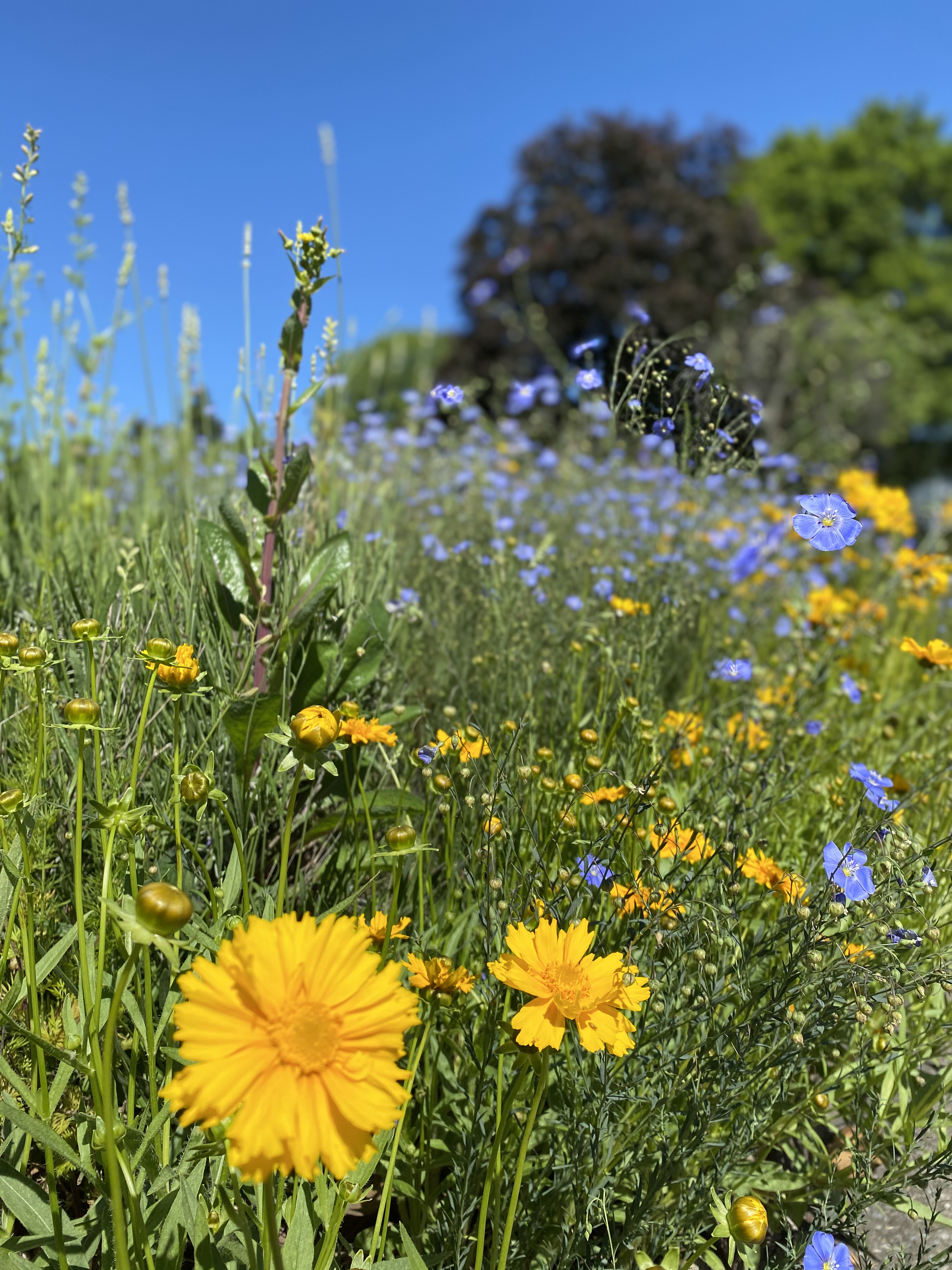
Flowers on point!
On rides this over-the-top there is always an unexpected challenge.
I suffered the worse kind of flat: a cut side wall. I had numerous tire plugs, two tubes, and a pump. I’d expected at least one flat along the way, and was prepared for more. The first fix worked, but the plug was rubbing the frame and I had no razor or knife to trim it with. I accidentally pulled it trying to cut it with my Mountain Dew can, making the hole worse. I had to tube it. This worked, but only for a half and hour of tender progress. I was in the middle of nowhere in the deepest forest you can imagine. I was late to the planned meeting point at Spruce Knob. Luckily, I ended up making it an hour to the pavement before riding some rim.
I tried to call my wife Erin who was ready to assist, but this area is in the National Radio Quiet Zone for the huge radio observatory in Green Bank. I literally had no cell signal for 100 miles. If you put a radio on search mode, it just circles through the stations on infinite repeat finding nothing. Erin and our kids had had driven from our house to Spruce Knob, where we’d planned to meet. Then they searched for me on the gravel road ascent. Eventually she decided to drive home, hopeful that I’d cut the route short and would be on the Virginia side of Shenandoah Mountain. Finally, I made it to Franklin, West Virginia where there is cell service and we were able to connect. I sat there, despondent on the side of the road. I was lucky they
came back and rescued me.

The Kracken did succeed in having me in the box and rewarded like Kanza. And I forged a keeper route that is super rad.
capability versus challenge.
This mission was more than I should have taken on, given the circumstances. It relied on things going perfect, or at least as-planned. I’d not properly considered that adventures this ambitious never go as planned.
Would I do it again? Hell, yeah. But I would prepare like it’s a bike-packing trip through Alaska.
Lessons learned:
When picking an adventure, you must create a solid plan. Part of this is by assessing capability versus the challenge. Secondly, you must factor in uncertainty and how that create a risk multiplier of the unknown. Lastly, have a solid emergency plan with some built-in redundancies. Admittedly, I had some additional back-ups built into my plan, but in my exhaustion I didn’t follow through with them.
I have solid fitness, a great bike, and I knew it was a low-traffic route. Normally I’d sign it a moderate risk level, but the 200+ miles pushed into a more likely for high-risk adventure. Looking back, the lack of cell phone service, plus the untested route, plus the pandemic-effect of not being able to jump in a car with a stranger for ride was the final thing that put my plan into the might-be-a-bad-idea RED Zone.
My plan had holes in it.
Will I do it again? Definitely. After I apply the lessons learned:
#1 Don’t mess with The Kracken. Understand it’s not a bike ride, but an expedition.
#2 Ride with a satellite phone or Spot Tracker. Get a prepaid phone SD card for all other carriers.
#3 Bring a spare tire!
At 2,656 square miles, Monogohala National Forest is big, and super awesome.
P.S. In a couple of days, I will finish the un-ridden portion of the route to see how the rest of it rolls.


You must be logged in to post a comment.